Why Magnesium Comes in Different Forms
Magnesium never appears on its own in a capsule — as a mineral, it always needs to be bonded to another compound to be stable and usable in a supplement. Depending on what it's bonded to, the resulting "form" of magnesium can behave a little differently: some forms dissolve more readily, some are gentler on the stomach, and some are simply more common and cost-effective to manufacture. This is why formulators sometimes combine several forms into one blend rather than relying on a single source.
The Five Forms in a 5-in-1 Complex
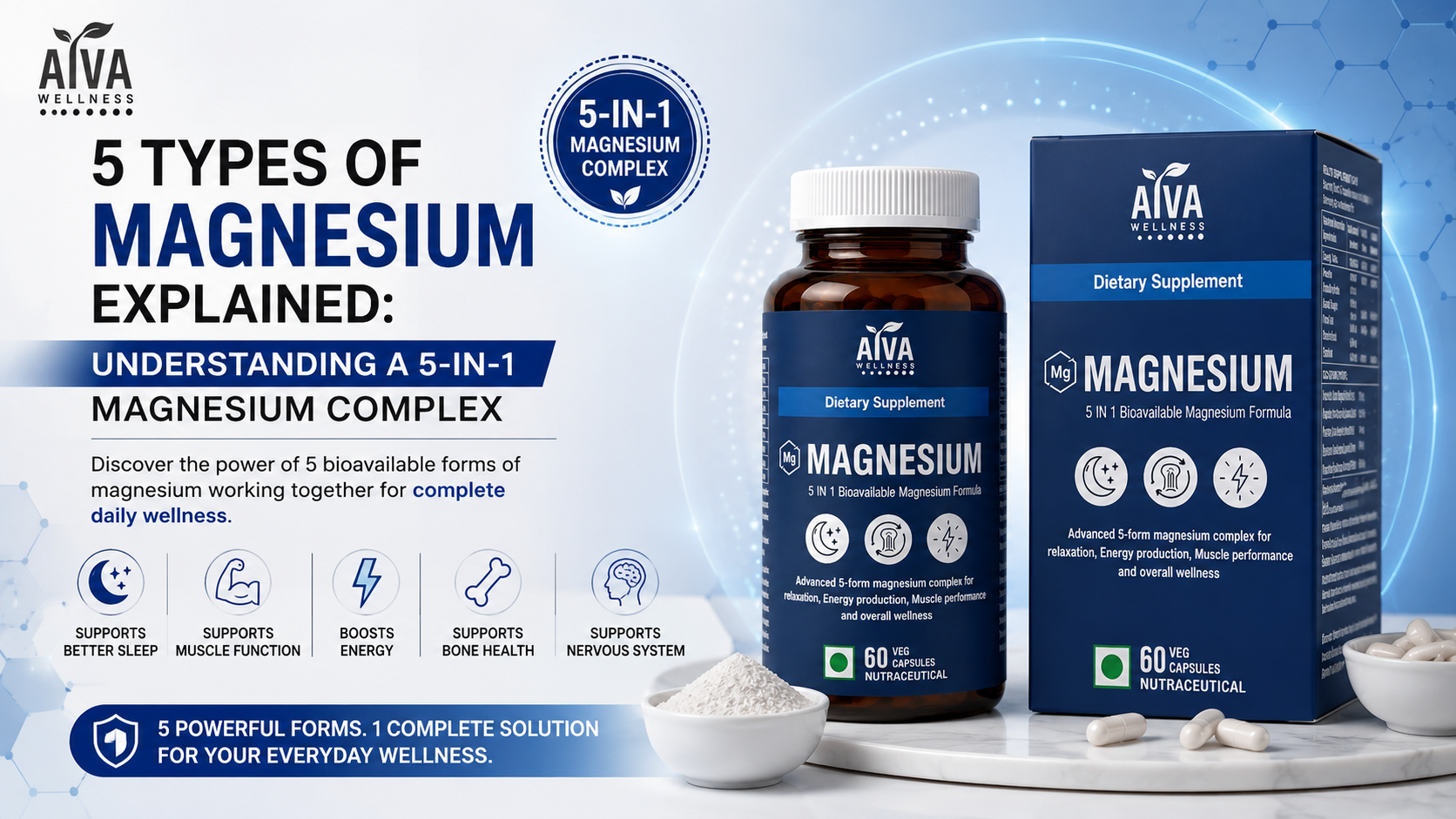
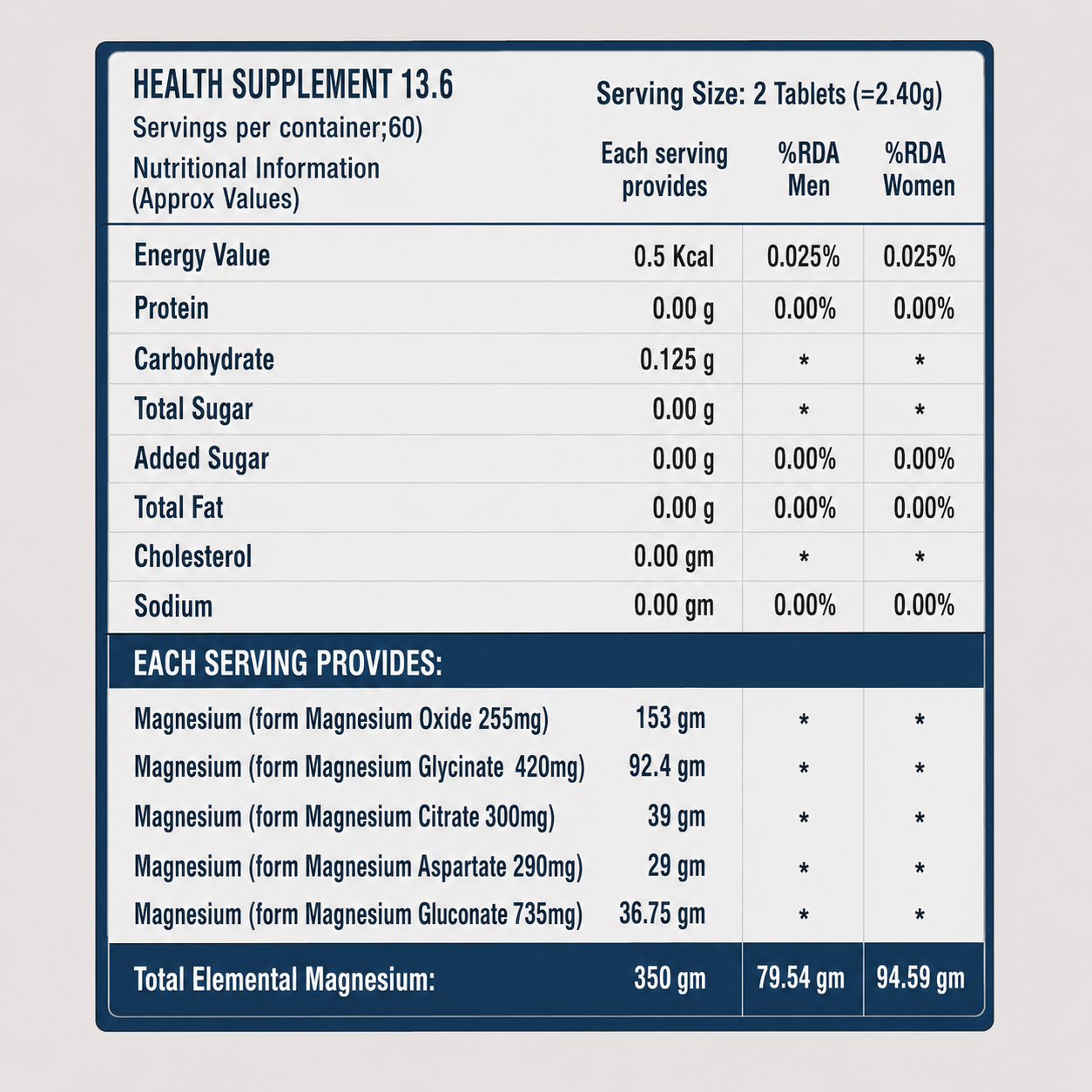
According to the Aiva Wellness Magnesium Complex 5-in-1 product specification, each serving (2 tablets) combines the following five forms:
- Magnesium Oxide — 255 mg, providing 153 mg of elemental magnesium. A widely used, cost-effective form.
- Magnesium Glycinate — 420 mg, providing 92.4 mg of elemental magnesium. Bonded to the amino acid glycine.
- Magnesium Citrate — 300 mg, providing 39 mg of elemental magnesium. Bonded to citric acid.
- Magnesium Aspartate — 290 mg, providing 29 mg of elemental magnesium. Bonded to aspartic acid.
- Magnesium Gluconate — 735 mg, providing 36.75 mg of elemental magnesium. Bonded to gluconic acid.
Together, these five forms provide a stated total of 350 mg of elemental magnesium per serving in the Aiva Wellness formula. Combining multiple forms is one approach formulators use when designing a magnesium blend, though it's worth noting that comparative research on whether blended formulas offer a meaningful advantage over a single well-absorbed form is still limited.
Understanding "Elemental Magnesium"
You'll notice the milligram figure for each compound (e.g., "420 mg" for Magnesium Glycinate) is always larger than the elemental magnesium figure (92.4 mg). That's because the compound weight includes the carrier molecule (glycine, citrate, etc.) as well as the magnesium itself. The elemental magnesium figure is what actually matters for intake purposes, since it reflects the amount of magnesium your body can potentially use — which is why supplement labels report a total elemental magnesium figure alongside the individual compound weights.
Magnesium's General Functions in the Body
Magnesium is involved in hundreds of biochemical reactions in the body. In general terms, it is commonly discussed for its role in:
- Normal bone structure — magnesium works alongside calcium and vitamin D in bone-related processes.
- Normal muscle function — including muscle contraction and relaxation.
- Normal energy-yielding metabolism — magnesium is involved in how the body converts food into usable energy.
- Normal nervous system function — magnesium plays a role in nerve signalling.
If you'd like to explore how magnesium relates specifically to sleep and relaxation, see our article on magnesium for sleep, relaxation & everyday wellness.
This article is for general educational purposes and is not medical advice. This product contains magnesium in multiple forms and is not intended to diagnose, treat, cure, or prevent any disease. Please consult your healthcare practitioner before use if you are pregnant, lactating, have kidney concerns, or are managing an existing health condition.
How to Read a Magnesium Label
When comparing magnesium supplements, a few things are worth checking on the label:
- Total elemental magnesium per serving — the figure that reflects actual usable magnesium content.
- Which forms are included — a 5-in-1 blend will list each compound and its individual elemental contribution.
- Serving size — whether the stated amount is per tablet or per multi-tablet serving.

Frequently Asked Questions
Different magnesium compounds behave a little differently in terms of how they dissolve and how much elemental magnesium they contribute. Some formulas combine several forms into one blend, though comparative research on blended versus single-form formulas is still limited.
Elemental magnesium is the actual amount of magnesium in a compound, excluding the weight of the carrier molecule it is bonded to. It is the figure most relevant for understanding intake.
According to the product label, each two-tablet serving provides a total of 350 mg of elemental magnesium across the five combined forms.
Different forms of magnesium have different properties, and no single form is universally best for everyone. Any specific comparison or recommendation is best discussed with a healthcare professional.
The Takeaway
A 5-in-1 magnesium complex combines several bonded forms of magnesium into one formula, each contributing to a total elemental magnesium figure. Understanding what's behind that number makes it easier to read labels with confidence and have an informed conversation with your doctor about what fits your routine.
Referenced Research & Sources
- Aiva Wellness — Magnesium Complex 5-in-1 product specification sheet
- National Institutes of Health, Office of Dietary Supplements — Magnesium Fact Sheet
- ICMR (Indian Council of Medical Research) — Nutrient Requirements and RDA for Indians, 2020